




FAQ’s
We aim to quickly answer any questions, to help reduce support requests and to build trust by addressing concerns transparently and consistently.
What is BHN
BHN is a UK MedTech developing a portable EEG headband and app that directly measure brain activity and use AI for instant, objective triage of suspected head injuries without visiting hospital.
Built for sport, military, and industry, it supports fit-to-play/seek-care decisions, integrates with HL7 EHRs, and enables longitudinal tracking to reduce missed mTBI and speed care.
What is the BHN head band and app?
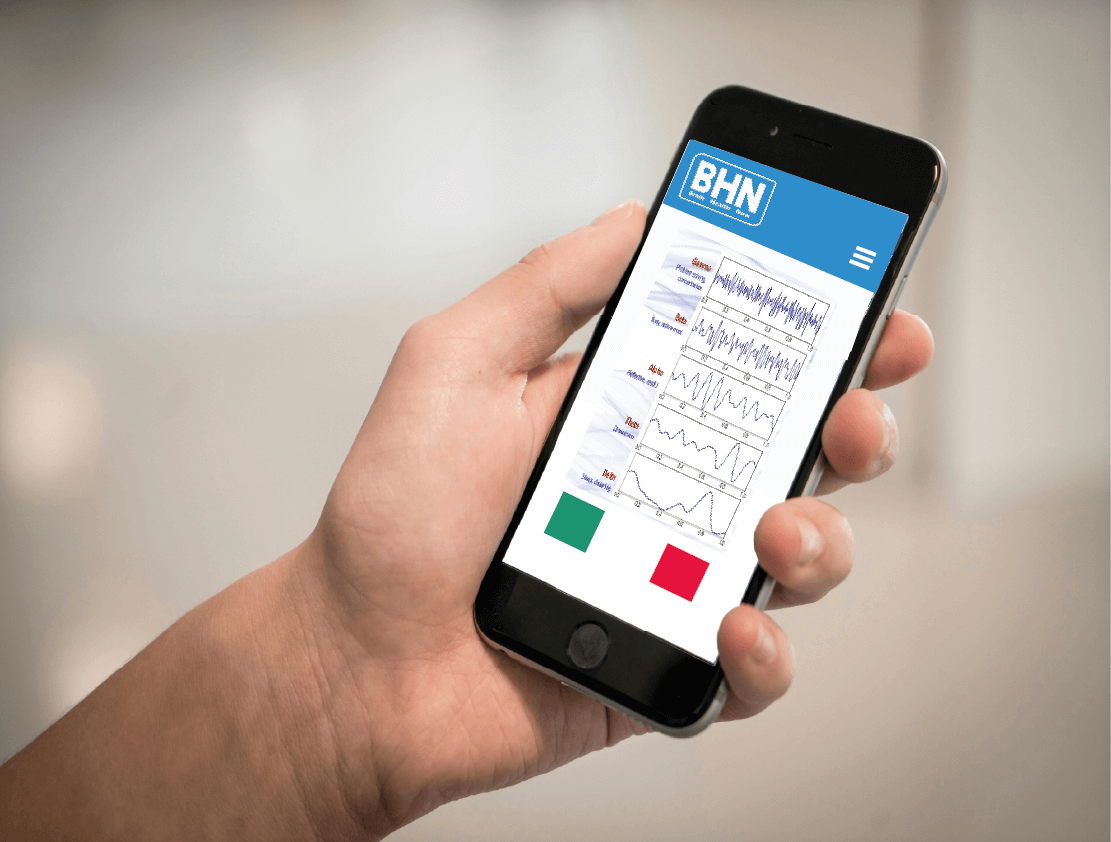
A lightweight headband with five flexible electrodes pairs via Bluetooth to a smartphone app, which guides a brief test, records brainwave responses, and uses AI to deliver immediate red/green status with guidance.
Results are stored securely for longitudinal tracking supporting quick “fit to play” or “seek care” decisions in sport, military, and industrial settings.
How does BHN work?
BHN delivers a three-minute auditory sequence while the headset records the brain’s electrical activity (EEG).
This elicits auditory evoked potentials (AEPs), which a secure AI model analyses to produce a clear red/green status indicating level of concern for head injury.
The app then provides recommended interventions and guidance for immediate management and return-to-play/service protocols.
How long does the test take?
End-to-end, the test takes about five minutes—covering headset fitting, sensor impedance verification, and the auditory sequence.
Results are delivered instantly and can be acted on immediately without specialist input.
Is a Baseline needed?
A separate baseline is not required for P300 detection when machine-learning models are trained on raw EEG. Unlike conventional workflows that rely on trial averaging and baseline correction, real-time ML can identify the P300 component directly without an explicit baseline.
Does BHN need regulatory approval?
BHN is committed to scientific credibility and future clinical applicability. We are conducting clinical validation studies in real-world settings to evidence performance and build the foundation for future medical use, regulatory pathways, and broader adoption.
The current system is non-diagnostic and supports return-to-play/service protocols—akin to consumer wearables—so we are not seeking regulatory clearance for this use. In parallel, we plan clinical studies exploring applications in neurological disorders (e.g., dementia and motor neurone disease).
Who can perform the test procedure?
The procedure can be administered by non-clinicians after brief onboarding; no formal qualifications are required.
For the initial trials, testing will be conducted by clinical staff affiliated with Super League clubs.
What is the science behind BHN?
Extensive research shows that event-related potentials (ERPs)—time-locked EEG responses to sensory, cognitive, or motor stimuli (including TMS paradigms)—are sensitive to brain injury.
Because they reflect shared neurophysiological mechanisms, injuries often produce characteristic changes in ERP latency and amplitude. BHN’s device records these signals and classifies them as normal or abnormal.
How is the data analysed?
Results are processed by a secure, cloud hosted ML model and shown in the mobile app as a clear red/green status with protocol-guided next steps.
The severity framework is clinician defined using multimodal evidence, video analysis, instrumented mouthguard data, Head Injury Assessment (HIA) outcomes, and BHN EEG readouts, to train the algorithm.
Classification is repeated during return-to-play/service to track recovery and confirm suitability.
Who decides when the brain is ready to resume activities?
If the app indicates Red, follow protocol and retest at prescribed intervals until it shows Green.
At Green status, resume activities per return-to-play/service guidelines.