

The legal action against rugby union’s authorities took a decisive step forward on Thursday when the firm representing nine players diagnosed with long-term brain injuries sent pre-action letters of claim to World Rugby, the Rugby Football Union and the Welsh Rugby Union. Rylands Law also revealed the identities of two more of the nine players involved in the test cases alongside Steve Thompson, Alix Popham and Michael Lipman. They are the former Wales under-20 centre Adam Hughes and the former England under-21 back-row Neil Spence.
The development comes as the former England captain Dylan Hartley spoke out about the lack of teaching in rugby around the risk of dementia. “From when I started until last week, I didn’t know dementia was a potential outcome for any rugby player,” Hartley said on RugbyPass’ Offload podcast. “That wasn’t educated or taught to us.” Hartley admitted he is having his “own problems” with concussion in retirement, but said he does not want to reveal more about them.
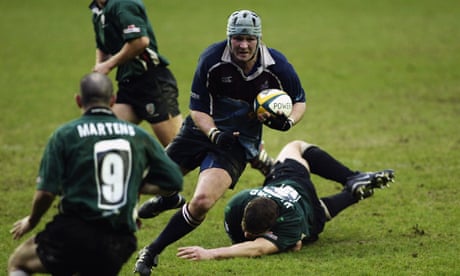
Hughes, 30, is the youngest player involved in the action so far. He has been diagnosed with “having brain injuries and post-concussion symptoms”, and has been told he is on a “similar medical trajectory” to Popham, Lipman, Thompson and Spence, who have all been diagnosed with early-onset dementia and probable chronic traumatic encephalopathy. Hughes played for the Dragons, Bristol and Exeter between 2010-18, and his experience throws doubt on the argument that the game has become significantly safer in the past decade.
Hughes was forced to retire at the age of 28 after a particularly severe concussion and is now working as a financial adviser. “It was just one head knock too many. I was finding it more and more difficult to recover from each and every bang to the head,” he said. He reports being knocked out eight times in his career. “At first it was the bigger concussions where I was completely knocked out that took me ages to recover from then over the time even the smaller ones started to have an impact. For the sake of my health, I had to bring it to a halt.”
One of Hughes’s former coaches, Rob Baxter at Exeter, said last week the game’s approach to head injuries has improved so much in the years since Thompson, Lipman and Popham retired that “there’s almost very little value in trying to compare the two”. Hughes, who played for the Chiefs in 2014-15, told a different story. “For me, I think the biggest issue around concussions was attitude. It was often treated like a weakness if you don’t dust yourself down and carry on.”
He added that “the game still has a very long way to go in terms of education about concussion”.

Four more players involved in the test cases have decided to remain anonymous. Rylands Law is already representing around 100 former rugby players and said 30 more have been in contact since the involvement of Thompson, Popham and Lipman was revealed by the Guardian last week.
In a statement World Rugby, the RFU and the WRU said: “We have been deeply saddened to hear the brave personal accounts from former players. Rugby is a contact sport and while there is an element of risk to playing any sport, rugby takes player welfare extremely seriously and it continues to be our number one priority. As a result of scientific knowledge improving, rugby has developed its approach to concussion surveillance, education, management and prevention across the whole game.
“We have implemented coach, referee and player education and best-practice protocols across the game and rugby’s approach to head injury assessments and concussion protocols has been recognised and led to many other team sports accepting our guidance. We will continue to use medical evidence and research to keep evolving our approach.”
Sir Bill Beaumont, the chairman of World Rugby, added: “As a player who retired on medical advice in the early 1980s, I care deeply about the welfare of all players. As an administrator, I will do all I can to maintain the confidence and wellbeing of those who play the game.”
The pre-action letters of claim set out the broad allegations upon which the cases are based. They state the governing bodies had a duty “to take such steps and to devise and implement such rules and regulations as were required in order to remove, reduce or minimise the risks of permanent brain damage as a consequence of the known and foreseeable risk of concussive and sub-concussive injuries”.
They also allege the risks of concussions and sub-concussive injuries were “known and foreseeable”, listing 24 failures on the part of World Rugby, RFU and WRU. The governing bodies have a maximum of three months from the date of acknowledgment of the letters of claim to provide their initial responses.