
Two more named in Players' dementia action

The legal action against rugby union’s authorities took a decisive step forward on Thursday when the firm representing nine players diagnosed with long-term brain injuries sent pre-action letters of claim to World Rugby, the Rugby Football Union and the Welsh Rugby Union. Rylands Law also revealed the identities of two more of the nine players involved in the test cases alongside Steve ThompsonAlix Popham and Michael Lipman. They are the former Wales under-20 centre Adam Hughes and the former England under-21 back-row Neil Spence.

The development comes as the former England captain Dylan Hartley spoke out about the lack of teaching in rugby around the risk of dementia. “From when I started until last week, I didn’t know dementia was a potential outcome for any rugby player,” Hartley said on RugbyPass’ Offload podcast. “That wasn’t educated or taught to us.” Hartley admitted he is having his “own problems” with concussion in retirement, but said he does not want to reveal more about them.
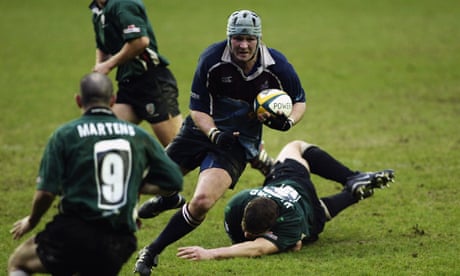
Neil Spence during his playing career at Rotherham.
‘A side of me is lost for ever’: two more rugby players on their brain injuries

Hughes, 30, is the youngest player involved in the action so far. He has been diagnosed with “having brain injuries and post-concussion symptoms”, and has been told he is on a “similar medical trajectory” to Popham, Lipman, Thompson and Spence, who have all been diagnosed with early-onset dementia and probable chronic traumatic encephalopathy. Hughes played for the Dragons, Bristol and Exeter between 2010-18, and his experience throws doubt on the argument that the game has become significantly safer in the past decade.

Hughes was forced to retire at the age of 28 after a particularly severe concussion and is now working as a financial adviser. “It was just one head knock too many. I was finding it more and more difficult to recover from each and every bang to the head,” he said. He reports being knocked out eight times in his career. “At first it was the bigger concussions where I was completely knocked out that took me ages to recover from then over the time even the smaller ones started to have an impact. For the sake of my health, I had to bring it to a halt.”

One of Hughes’s former coaches, Rob Baxter at Exeter, said last week the game’s approach to head injuries has improved so much in the years since Thompson, Lipman and Popham retired that “there’s almost very little value in trying to compare the two”. Hughes, who played for the Chiefs in 2014-15, told a different story. “For me, I think the biggest issue around concussions was attitude. It was often treated like a weakness if you don’t dust yourself down and carry on.”

He added that “the game still has a very long way to go in terms of education about concussion”.

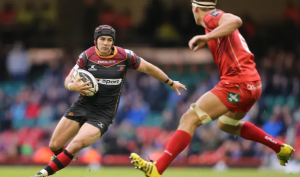
Adam Hughes (left), pictured in action for Dragons in 2016, retired age 28 after a severe concussion.
Adam Hughes (left), pictured in action for Dragons in 2016, retired age 28 after a severe concussion. Photograph: Huw Evans/Shutterstock

Four more players involved in the test cases have decided to remain anonymous. Rylands Law is already representing around 100 former rugby players and said 30 more have been in contact since the involvement of Thompson, Popham and Lipman was revealed by the Guardian last week.

In a statement World Rugby, the RFU and the WRU said: “We have been deeply saddened to hear the brave personal accounts from former players. Rugby is a contact sport and while there is an element of risk to playing any sport, rugby takes player welfare extremely seriously and it continues to be our number one priority. As a result of scientific knowledge improving, rugby has developed its approach to concussion surveillance, education, management and prevention across the whole game.

“We have implemented coach, referee and player education and best-practice protocols across the game and rugby’s approach to head injury assessments and concussion protocols has been recognised and led to many other team sports accepting our guidance. We will continue to use medical evidence and research to keep evolving our approach.”

Sir Bill Beaumont, the chairman of World Rugby, added: “As a player who retired on medical advice in the early 1980s, I care deeply about the welfare of all players. As an administrator, I will do all I can to maintain the confidence and wellbeing of those who play the game.”

The pre-action letters of claim set out the broad allegations upon which the cases are based. They state the governing bodies had a duty “to take such steps and to devise and implement such rules and regulations as were required in order to remove, reduce or minimise the risks of permanent brain damage as a consequence of the known and foreseeable risk of concussive and sub-concussive injuries”.

They also allege the risks of concussions and sub-concussive injuries were “known and foreseeable”, listing 24 failures on the part of World Rugby, RFU and WRU. The governing bodies have a maximum of three months from the date of acknowledgment of the letters of claim to provide their initial responses.

Sports’ Actions on Concussion

Football
As mentioned in the Select Committee’s report, The FA and PFA’s comprehensive FIELD research study looked into the incidence of degenerative neurocognitive disease affecting the long-term health of former professional footballers, assessing the NHS records of thousands of Scottish male professional footballers.

The results showed that on average, the former footballers lived over three years longer than the normal population and were less likely to die of many diseases such as heart disease or lung cancer. However, they were more likely to die of dementia. The health records of 11% of the former footballers who had passed away stated that they had died from dementia, compared to around 3% for the socio-demographically matched sample. The study also showed that the professional footballers in this research were around 3.5 times more likely to die of dementia than the matched population. However, overall, this group of former professional footballers did not on average die earlier of dementia than people living with dementia in the general population. The study was not able to determine what exactly causes the increased rates of dementia.

Trial concussion substitutions started in the Premier League on 6 February 2021. The new rule piloted in this trial means that permanent substitutions can be made if a player suffers a head injury, even if all replacements have already been used. To avoid potential abuse of the rule, opposition teams are also able to make a change at the same time. The FA has also allowed teams to introduce two concussion substitutes per FA Cup match from February 2021 onwards.

The Premier League also constituted a Head Injuries Advisory Group in early 2020. This group is composed of team doctors, medical experts and stakeholder representatives with a remit to discuss and review all aspects of the Premier League’s Brain Health Plan. In August 2021 the Premier League’s first Head Injury Research Fellow commenced work with the organisation and it is hoped that this post will galvanise data collection and research activity in this vital area.

The Premier League is currently in the process of forming an independently chaired Football Medical Governance Group composed of senior medical and legal professionals alongside selected members of club medical staff. It is envisaged that the group will meet for the first time in December 2021 and will meet quarterly thereafter.

Rugby Union

The RFU’s HEADCASE education programme aims to increase understanding and provide information on concussion and other related topics, including how to prevent and manage suspected concussions.
These guidelines are intended to manage concussion at all levels of adult and age grade community game , including how to recognise a suspected concussion, how it should be managed, and good practice to reduce the risk of concussion in players.

At all community levels of rugby, if a player displays one or more observable signs or symptoms of concussion, the guidance stresses that they should be removed from the pitch immediately irrespective of whether it is a match or training session. The player should then follow the appropriate Return to Play programme (either U19 and below or adult). The HEADCASE online awareness module accompanies the guidelines with more detailed information, and can be accessed via the HEADCASE homepage.

Rugby League

The RFL has a detailed set of protocols outlined under the banner, “Don’t be a Headcase”. Their website details background on concussion, information for coaches and teachers, ideas for prevention and recognition, return to play guidance, information for match officials and parents, as well as outlining resource material, such as poster summaries and information, including Pitchside Advice Cards.

Horse Racing

The British Horseracing Authority (BHA) maintains a database of all jockeys’ injuries, including those incurred off the racecourse, which is accessible by all racecourse doctors. BHA has particular procedures in place for jockeys returning to race following concussion. BHA also monitors the progress of injured jockeys to ensure that they only return to race riding once it is safe to do so.

Taekwondo

GB Taekwondo point to the Sport and Recreation Alliance’s concussion guidance on their website, aimed at professionals working in the education sector. They also receive support from Taekwondo’s National Governing Body, British Taekwondo (BT).
BT extends beyond World Taekwondo’s rules on head injuries, with a best practice approach (with consideration of The FA, World Rugby and GB Taekwondo guidance) to cover BT Full Contact Training Events including in Club Sessions, Gradual Return to Play and a Gradual Return to Training.

Cricket

From 2018, the England and Wales Cricket Board (ECB) has ensured that each county team at first and second team level, must be supported by a medical professional who is qualified to make judgements on possible concussion following a head-strike. Concussion replacements were also introduced for the first time in 2018, covering all four professional domestic competitions.

Boxing

England Boxing’s Rule Book contains concussion protocols, advice and guidance, for both under and over-18s.The protocols stipulate a six step graduated return to competition for both under and over-18s, with a minimum 39 day period post-injury before returning to competition for under-18s and a minimum 35 day period for over-18s.

View Source Document Here

Previous Report

next Report